

Meedan’s design evolution: Illustrating the future
With 2026 here, we’ve updated our look. Find out what’s on our mind this year. Plus, learn about our latest research.
New year, new style
As you’ve no doubt noticed, we’ve given the Checklist a fresh coat of paint.
Since last year, we’ve been embarking on a widespread brand evolution. In keeping with our recent change in leadership and our drive to develop an AI-powered tool that serves the public interest — recently dubbed Suwali — we knew that it was time to take stock of how we express ourselves.
Our values remain unchanged. We’ve just got some new tools for sharing them.
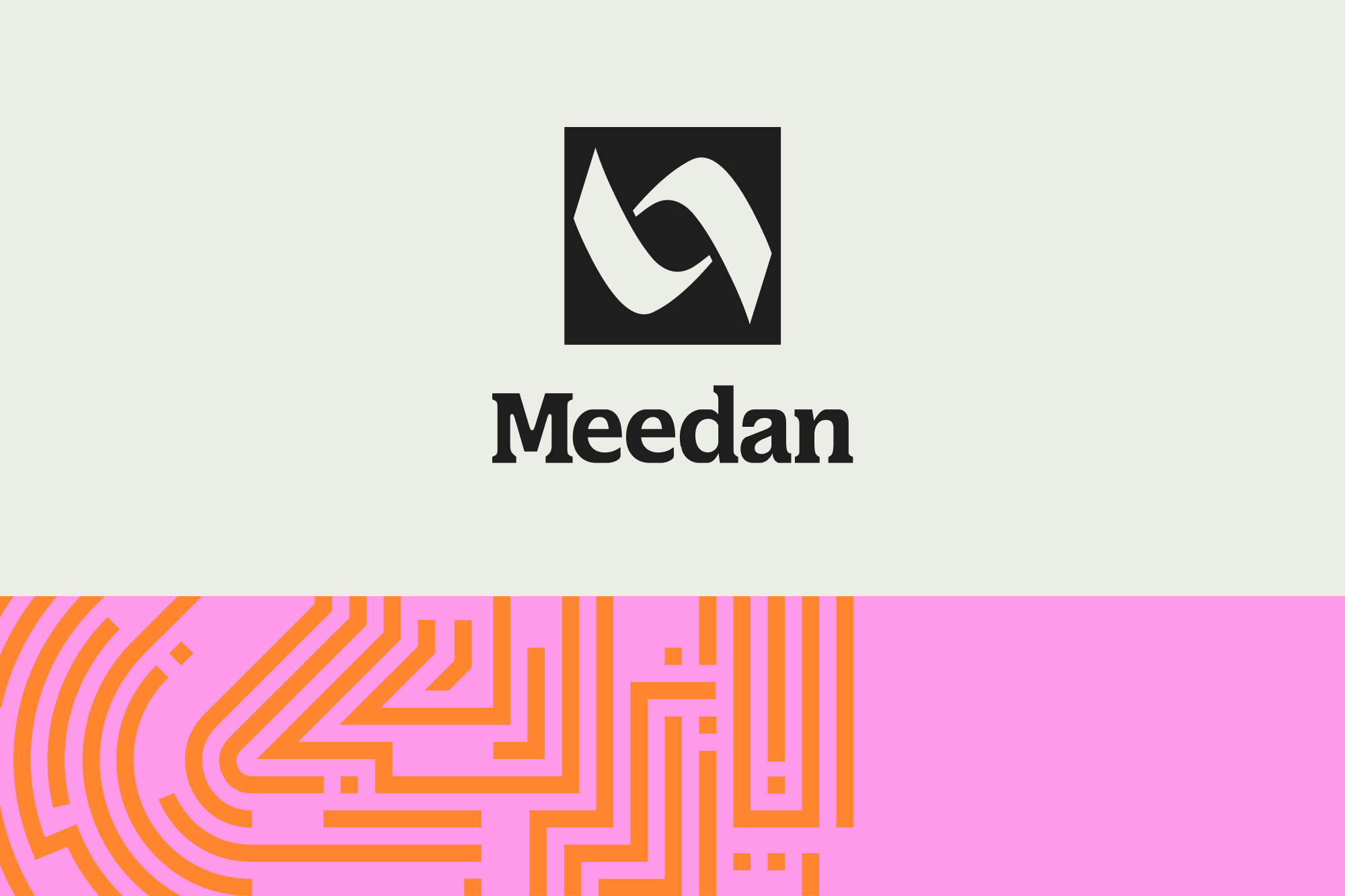
This is perhaps nowhere more evident than in Meedan’s new logo, created by our senior graphic designer, Kipp Jones.
Made of two interlocking scripts, the image is intended to evoke language, hyperlinks, and ultimately, the various pathways we all chart independently but that eventually merge together into vast knowledge networks.
Across our entire website, you’ll notice further navigational, editorial, and graphic updates that we hope will bring us closer to clarifying our vision in constant collaboration with the world around us.
Let’s mobilize knowledge networks together.
Gearing up for 2026
Our brand evolution, ongoing research, and tool building are just some of the ways we respond to the challenging climate of the moment.
In a recent interview with TechRadar, Access Now Executive Director Alejandro Mayoral Baños identified “surveillance, censorship, and shrinking civic space” as the top digital rights threats facing our world this past year. Indeed, in the absence of robust regulatory guardrails, we’re seeing the ascendancy of tools ranging from killer robots to Grok and its ability to “undress” photos of unsuspecting women. It’s clear that there’s a steep climb ahead.
But AI is hardly a monolith — we know that narrowly bound deployments of AI can help advance information equity. A 2025 year-end Reuters Institute industry survey on media and technology in 2026 revealed that, while newsrooms remain skeptical of the output generated by leading commercial AI products, many view some forms of artificial intelligence as operationally important. The survey’s most popular AI use cases centered on coding, development, and task automation. More than 80% of respondents also said artificial intelligence would be somewhat or very important for newsgathering efforts, including finding stories.
We agree. That’s why we’re keen to introduce our readers to Suwali, a new tool that provides narrowly tailored, purpose-built AI features to help newsrooms inform, listen to, and learn from their readers, all at scale.
Collaborative research: Identifying gender-based violence online in the Larger World
While Grok’s undressing capabilities have made plenty of headlines lately, we know that the problem of gender-based violence is nothing new in digital spaces and that it is not constrained to any one platform or region.
Online gender-based violence is particularly acute in the Larger World, but too often, research isn’t designed to suit the local contexts and languages of the communities that are most affected by this problem. Our latest research efforts are helping to tackle the issue by working with partners in the regions of sub-Saharan Africa and North Africa and Western Asia to gather examples of harmful content and build datasets and algorithms that can help us better identify and counter digital misogyny in Arabic, African French, and Swahili.
Read what we’re up to.
Contact us to explore collaboration opportunities.

Townsquare
Jan. 30
The Digital Rights and Inclusion Forum is now accepting proposals for in-person sessions that address the theme of building inclusive and resilient digital futures. Hosted by Paradigm Initiative, this annual convening allows participants to share experiences, present research outcomes, and collaborate to advance internet freedom. This year, the event will be held in Abidjan, Ivory Coast, from April 14-16. Submit proposals by Jan. 30.
Jan. 31
The Digital Rights Fund, an initiative of SMEX, is now accepting proposals from groups and individuals in North Africa and Western Asia who are responding to current regional threats in concert with SMEX’s commitment to building a free, open, secure, and inclusive digital environment. Submit your proposal by Jan. 31.
Feb. 20
RightsCon 2026 will be hosted in Zambia from May 5-8 by Access Now. At RightsCon, participants from around the world convene, connect, and contribute to a shared agenda for the future with a global community of business leaders, activists, technologists, policymakers, journalists, philanthropists, researchers, and artists. Register by Feb. 20 to take advantage of early bird prices.
Feb. 20
The Catalyst Public Policy Champions Programme is now accepting applications. This fully funded professional development opportunity is designed to equip policymakers and practitioners with the knowledge, skills, and networks needed to design and implement effective responses to forms of hybrid online harm, terrorism, and violent extremism intersecting with technology-facilitated gender-based violence. Apply by Feb. 20.
What we’re reading
“Let’s look at the immediate consequence of this harassment: silencing. Women will inevitably fear being present online, not just on X but on any platform where their image can be taken and transformed — whether that’s their LinkedIn profile where they share their professional news, Instagram, or Tiktok. In fact, Grok laid it out very clearly for us. Answering a post from an upset user, it wrote ‘if you can’t handle innovation, maybe log off.’”
(Chayn)
“What we are seeing is not a single disinformation campaign but something much messier. Iran’s information ecosystem has been shaped by extreme distrust of the Islamic Republic’s official media; social-media influence efforts coming from both the regime and foreign powers; and rampant distortions of online content — some deceptive, some careless, some well intentioned — that make verifying what Iranians are actually saying or doing during these protests difficult.”
(Mahsa Alimardani, The Atlantic)
“Legal documents outline the use of Cellebrite’s forensic data extraction tool on phones owned by activists detained by Jordanian police. They show that the tool is able to extract the entire contents of the phone, giving law enforcement access to information including passwords, app data, images, and documents.”
(Organized Crime and Corruption Reporting Project and The Citizen Lab)
Sign up for the Checklist
The Checklist is currently read by more than 2,100 subscribers. Subscribe for free to receive Meedan’s monthly updates on global media, technology, and our efforts to build a more equitable internet.
Did you miss an issue of the Checklist? Visit the Checklist archive. We've explored a diverse range of subjects, including women’s and gender issues, crisis-response strategies, media literacy, elections, AI, and big data.
Support our work
Help Meedan continue building open source software and innovative global programs. Your contribution is greatly appreciated.